
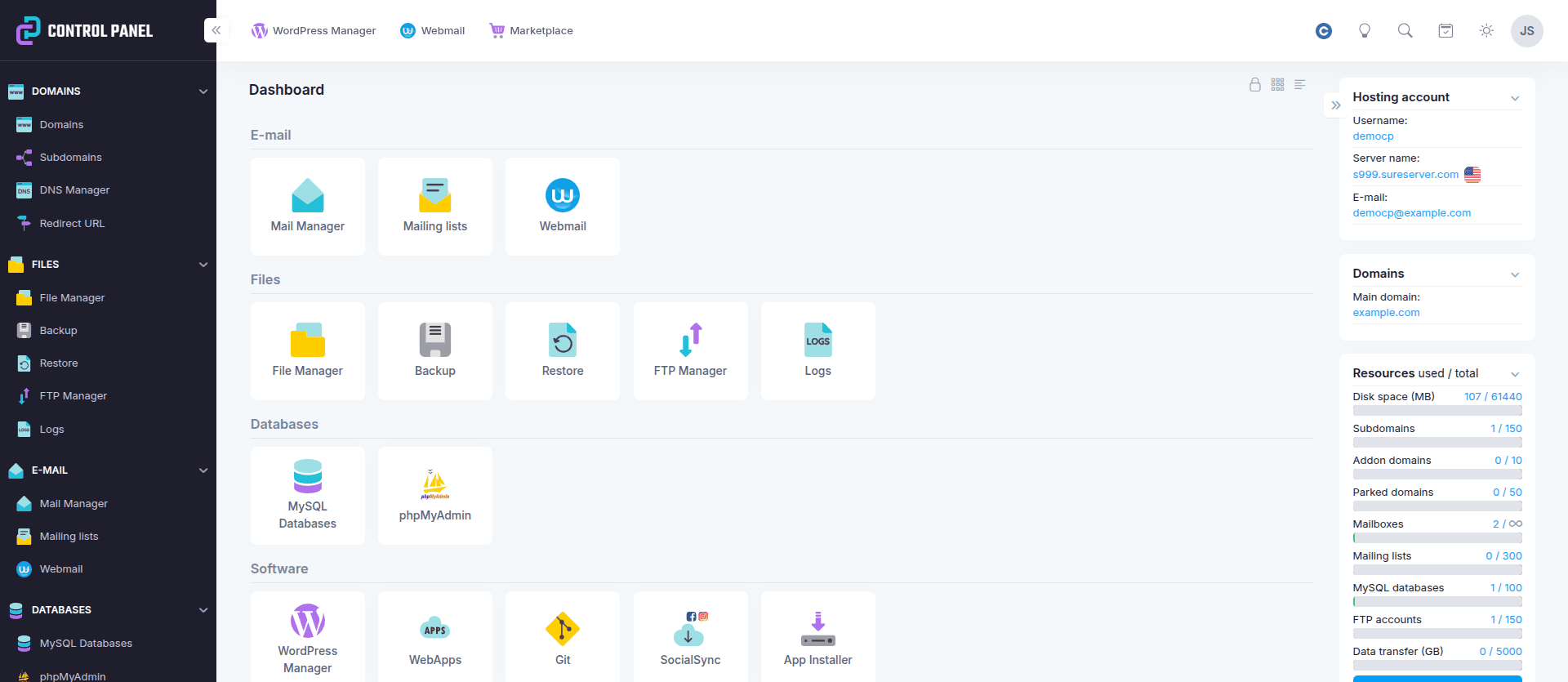
Cloud hosting has grown rapidly in recent years, yet shared web hosting remains the most widely used type of hosting. One of its main advantages is the ease of management: shared hosting plans typically include a hosting control panel. This is a graphical interface that allows users - even those with little or no technical experience - to manage the services included in their hosting plan with ease. Hosting control panels have existed since the late 1990s and early 2000s. As in many other industries, a small number of major players dominate the market. That said, some hosts have long relied on their own custom-built panels, while others have recently begun transitioning away from commercial panels in favor of newly developed in-house solutions.
This shift is not accidental. Custom control panels offer several advantages over popular alternatives. As we have discontinued our Control Panel 2 in favor of the recently released Control Panel 3, we decided to take a closer look at these benefits. Having used a custom control panel for many years, we can share first-hand experience and insight into the decision to use an in-house solution.
- What exactly is a control panel?
- What are some popular panels?
- What is a custom control panel?
- Why use a custom control panel?
- Evolves around our infrastructure
- Better security
- Faster integration of new technologies
- No license fees and no third-party dependency
- Changes take minutes, not days
- Easy issue reproduction and faster fixes
- Easier integration with other systems
- Customer-oriented solutions are possible
- Wrap-Up
What exactly is a control panel?
Most users are familiar with the term, but for those with little or no prior experience, a hosting control panel is essentially a web-based interface used to manage a hosting account instead of relying on the command line. Control panels are designed to simplify common administrative tasks and make them accessible to non-technical users.
Typical features found in most control panels include website management (such as domain and subdomain configuration, file uploads, and file modification), database management, email account administration, script installation, monitoring, and more. The exact set of services and the tools used to manage them can vary depending on the specific control panel. It is also worth noting that not every web-based interface qualifies as a hosting control panel in the strict sense.

What are some popular panels?
Several hosting control panels are widely used by a large number of hosting providers and have been on the market for many years. Well-known examples include cPanel, Plesk, DirectAdmin, and Webmin. In addition to these, there are also less mainstream panels that have existed for a long time, such as aaPanel, ISPConfig, and Control Web Panel (CWP). What all these solutions have in common is that they are used by large communities across multiple platforms to manage websites and hosting services.


Using established control panels - especially the more popular ones - comes with clear advantages. They typically offer quick setup and support a wide range of hardware and server configurations. Their user interfaces are familiar to many users, which is why customers often specifically request them when choosing a hosting provider. Familiarity also reduces friction during server migrations. Finally, popular control panels usually come with extensive documentation and active community forums, making it easier to find guidance and troubleshooting help.

That said, despite these advantages, we believe that using a custom control panel is ultimately the better choice.
What is a custom control panel?
By "custom control panel", we mean a tool that is developed and maintained by the same provider that offers the hosting service, rather than software that is purchased or licensed from a third party. While relatively few companies use custom-built panels, their number has increased over the past several years.
ICDSoft is one of the providers that uses a custom control panel. Unlike many others, we have been using our own software for more than 20 years. Because our top-rated technical support team migrates websites from other providers on a daily basis, we also have extensive, hands-on experience with the control panels those providers use. This allows us to say with confidence that a custom control panel offers clear advantages over the available alternatives.


Below, we will outline some of these advantages. While they may not apply to every custom control panel or every provider, they are all valid for our Control Panel.
Why use a custom control panel?
Evolves around our infrastructure
Having our own control panel allows us to develop and use software that is built specifically for our hardware and infrastructure. Popular control panels must support a wide range of hardware configurations and server setups, which often requires compromises in terms of performance or functionality in order to maintain broad compatibility.
Our Control Panel, on the other hand, is optimized exclusively for our own environment. This allows us to adapt and fine-tune it whenever we scale or change our infrastructure. It includes all the features that we actively support – without unnecessary options.
Better security
Using a custom control panel significantly improves overall server security. Unlike widely used commercial panels, custom solutions are far less attractive targets for automated and large-scale attacks, as they are not deployed across thousands of servers and their internal architecture is not publicly documented. Most importantly, if a security vulnerability is discovered, it can be patched immediately.
With commercial control panels, fixes are typically released only when the vendor publishes a new minor version, following their standard release schedule. After that, hosting providers often need additional time to test the patch across their specific server setups before deployment. During this window, servers running the affected control panel remain vulnerable.

Faster integration of new technologies
With a custom control panel, new technologies can be integrated quickly and efficiently. Adding new PHP versions, updating system packages, or introducing new software does not require waiting on third-party vendors. The process is streamlined because our developers are deeply familiar with the underlying infrastructure and can integrate new technologies as they are needed.
Any new section or service we introduce can be built directly into the control panel, without relying on additional plugins, workarounds, or hacks.


No license fees and no third-party dependency
Deploying and maintaining a custom control panel requires time and investment, but in the long run, it pays off. There are no recurring license fees, which means there are no hidden costs passed on to our customers. We are also not tied to the pricing model of a third party that can unilaterally increase licensing fees at any time.
Just as importantly, we do not depend on another provider for a core service used to manage hosting accounts. Instead, we can invest those resources directly into improving our services and developing new ones.

Changes take minutes, not days
When an update is needed - whether it is a security fix, a new feature, or an improvement to an existing function - the changes can take effect within minutes. We are not bound by a complex release cycle that stretches over days.
In contrast, providers that reply on third-party control panels often face vendor lock-in. They may be unable to apply fixes themselves and must either wait for an official release or resort to unofficial workarounds. This is particularly problematic for minor bugs that, while not critical, can remain unresolved for long periods of time.

Easy issue reproduction and faster fixes
No matter how well-designed a piece of software is, bugs are inevitable – whether functional or visual. This applies equally to small applications and large platforms, regardless of their price or the size of the development team behind them.
When an issue is discovered in our Control Panel, we can reproduce it internally and fix it quickly because we are familiar with the codebase and the environment in which it runs. In contrast, popular third-party control panels also have bugs, but they are often difficult to reproduce. Many issues appear only under specific configurations or circumstances, and the vendor may be unable to replicate the exact setup.
As a result, such issues may remain unresolved. Commercial control panel vendors cannot reasonably release updates that affect hosting providers for a problem that occurs only on one platform, nor can they deliver fixes tailored to a single provider.

Easier integration with other systems
While a control panel is the primary tool for managing a standard hosting account, a hosting service relies on many other systems as well. Billing platforms, backups solutions, and internal monitoring tools are just a few examples, and all of them can be natively integrated if we use a custom control panel.
In our case, we have full access to the control panel’s codebase, and most of the related software is developed in-house. This greatly simplifies integration and allows us to manage processes such as account activation and suspension, automatic backup generation, account scaling, and more – all in a seamless and controlled way.

Customer-oriented solutions are possible
Using a custom control panel allows us to implement features suggested by our customers when we believe they add real value. This is a policy we have followed for years, and several features in both the hosting Control Panel and the Account panel were introduced as a direct result of user feedback.
Suggestions may relate to usability, shortcuts, design, or workflow improvements, and every idea we receive is carefully considered. Naturally, this does not mean that every request is implemented, or that changes are made based on the personal preferences of a single user. All proposed features go through the same development process as any other service, including usability reviews and quality assurance testing.
This level of flexibility is not possible with popular control panels used by many hosting providers, where any change would need to be applied globally across all customers of all providers. While some panels allow extensions or plugins, developing and maintaining such custom functionality is often impractical and rarely pursued.

Wrap-Up
The web hosting market continues to evolve, and hosting control panels evolve with it. While the majority of providers still rely on a handful of popular panels, some hosts - ICDSoft among them - use custom, in-house software.
Custom control panels offer a range of advantages: they are tailored to specific hardware and infrastructure, easier to manage, and less vulnerable to common security threats. They eliminate licensing fees, provide independence from third-party vendors, and allow for faster updates, seamless integrations, and customer-focused improvements. For these reasons, a well-designed custom control panel can deliver superior experience for both providers and their users.